google.com, pub-5827770858464401, DIRECT, f08c47fec0942fa0 https://misteri1963.blogspot.com.esgoogle.com, pub-5827770858464401, DIRECT, f08c47fec0942fa0https://misteri1963.blogspot.com.argoogle.com, pub-5827770858464401, DIRECT, f08c47fec0942fa0https://misteri1963.blogspot.com.cogoogle.com, pub-5827770858464401, DIRECT, f08c47fec0942fa0https://misteri1963.blogspot.com.brgoogle.com, pub-5827770858464401, DIRECT, f08c47fec0942fa0 Misteri1963

Translate

SPAIN ... a letter from 2050


by  Antonio Carlos Pereira-Menaut June 8, 2018
Website  CrisisMagazine


Antonio Carlos Pereira teaches Menaut
EU constitutional law at the University of
Santiago de Compostela, Galicia, Spain.
He is the author of several books including (with Celso Cancela-Outeda) restoration of constitutional engine of the European Union (2012)
Political Theory [Political Theory] (2015).


Technocracy  in Europe is assured, as many observers clearly understand.

This dehumanized future scenario in Spain is represented by a professor of Constitutional Law of the EU in Santiago de Compostela.

Trapped in the illusion,
"Information overload and a large number of datasets have made that people are unable to discern for themselves with no real official guide from the false, right and wrong, while the real and reality faded from the public mind for decades. "


In 2050, Spain, which was once a proud global empire of strong-willed people, he became the poster boy of Brussels.

Few countries have transformed their anthropology as completely and quickly. Modernization and Europeanisation technocratization have been pushed so dramatically that looks like a super vassal state of the EU.

The quest for democracy has given way while searching for conformity.The Spanish culture is as flat as an iron.

Spaniards have become "the Prussians of the South", unlike its earlier cousins, Italian, Portuguese and Latin American.


I. 
At first glance, what strikes you on the streets in 2050 are many robots, cyborgs and enhanced people .

The process of  becoming more like a machine than a human being  is underway. People are separated from physical reality, living their lives with data rather than things (Byung-Chul Han,  In the Swarm , 2017).

Technologization universal, ie machines that perform many tasks better than humans, has meant a gradual loss of human abilities, either predicting the weather or replacing a flat tire.
 
What Chesterton prophesied,
"The fires will be lit to testify that two and two make four. Swords will be drawn to prove that the leaves are green in summer" (Heretics, 1905)
... It happened in Spain for decades.

The era of common sense was long ago, because it involved human nature to experience a sense of proportion and ability to make judgments. Electronic devices, which have isolated people together for decades, now isolate people from physical reality. 

People live their lives according to official protocols. Nothing unforeseen happens. Apart from natural disasters, nothing "tests the souls of men".

Not solve any serious problems for yourself; Instead, you must go to a social worker.

If you have a problem, do not expect a helping hand from neighbors, but civil servants, which prevent people work things out for themselves (to escape a traffic jam on a frozen road, for example).

No one under 50 years has heard of taking responsibility for their free shares. Few people under 40 took radical decisions or overcome serious obstacles or significant hazards.

They have never gone through adversity that shape human personality. 

Unless they are professionally trained, people can not do simple things for themselves, how to cure everyday illnesses, attend bruising children or treat hyperactive children. If something happens, you should refer to public authorities. If you encounter an injured person, do not play the Good Samaritan, not whether they violate legal rules on the transport of injured or speed limits. 

With half a century of the new millennium passed, only a fraction of the Spaniards who come alive stumble through ordinary sex.

Only a few under 50 can cherish childhood memories in a reasonably stable with their biological parents and siblings family; even fewer have had a substantial relationship with their grandparents.

Rootlessness, both territorial and social, is the rule.

Since pedigrees are now extremely intermingled, one can not say correctly, for example,
"We, the Woosters, we had our code of honor since the Crusades"
... because there is no clear and undisputed line  Woosters .

From 2050, relationships between Spaniards, once famous for their strong feelings are weak, not excluding the maternal feelings of your child. The close friendship is rare, even among classmates.

Few couples who know how two young men began telling each other: "If you accept me protect you with my life," or something like that, like Nat Turner or Cherry in 'The Birth of a Nation'.

Lacking these strong, durable and personal commitments, personal relationships were weakened, transferred (new partners or new stepchildren) and (grieving parent or spouse) were deleted.

As expected, these malleable people are more controllable. 

There are redundant people. For the needs of a country des-industrialized in the 2050s, only a fraction of human labor is required.One can count millions of young unemployed and are docile, immature and aimless.

Welfare wages are a way of life for many. 

Shared common views, unless they are politically correct, are scarce.Personal growth is difficult. Prominent personalities are also rare because opportunities for self-expression and creativity are limited.oddballs difficult to find, even in universities.

Except among immigrants, no adult Spanish have had the experience of a child, escaping from the police after a little joke.

Penrod , and l young rascal of the work of  B. Tarkington , if it existed, would be under therapeutic supervision.


II. 
Apart from the diverted treated by psychiatrists, ordinary people live their lives through a series of stages regulated to make sure they fit, so that the development of brilliant qualities is rare.
 
Old prudential virtues necessary for our daily lives, atrophy. Few people develop wisdom based on the rule and nobody trusts themselves unless they have obtained a master's degree in self - sufficiency. 

Government, big media and entertainment industry determine the dominant public mindset.

By controlling the language, they have come to control thought. People celebrate what is expected of them:
mothers on Mother's Day, women on Women's Day, etc.
Very few people are "masters of their souls , " and many do not understand why they should be. 

All are observed, even when they go to the baker. Nobody complains because this universal monitoring is carried out not only the government but also its neighbor, your supermarket, employers, etc.

Full control of everything he does and says, that is, what it says to have a beer or raise their children, is in force, and in the near future, will have substantial control even what you think and want (your choices are partly induced by your mobile phone).

In general, the ability of most people to escape control, if desired, is scarce. Since the government, the EU and Google know everything about you anyway, slightly formal intelligence is needed. 

In 2050, the judges make decisions in fear of the opposition, as well as university professors and everyone else.

In this quasi-totalitarian regime transparent, people have become reserved and unable to act boldly, except in very small groups. Over time they have lost almost all memory of the sincere relationships.

The initial mutual trust is not taken for granted, and many just lose it.After decades refrain from autonomous action, this sum of transparency and oversight makes people refrain from thinking independently.

Behave and speak as officially expected until the contrary is thought - a typical practice of the old autocracies - is no longer the case; people now think within the framework politically correct.


III. 
The bio-power, once a novelty, is passé.

The psycho-power  now has the lead and is so ubiquitous that the " War on Terror " has become unnecessary. 

Following a trend that is not new, current political problems are political in nature:
instead refer to the human body, heart and mind, behavior, culture and ecology ...
Governments and international agencies no longer pretend that we are all equal; there are political and economic inequalities in abundance.Similarly, human dignity is rarely mentioned.

As expected, the presumption of innocence is no longer fashionable. 

Thought  political correctness  no longer intended to include democracy, which has now disappeared, not only for political or economic reasons, or because of the difficulties of expanding globally, but simply because people are trained to  do nothing  significant in itself same .

If you see each and every one of the problems, however simple (how long to spend his son playing video games), with an "expert" even what once were matters of nature, such as pregnancy, they become a matter expert, becomes totally unprepared to manage his family, let alone the police. 

Almost everything goes beyond the judgment of the "common man".

Things that Mother Nature set us - how to be a parent, a child or an active member of the police, are beyond our ability now. Adults are infantilized, they supervised therapeutically and lack personal initiative outside the field of vocational training. 

The law has also changed. Roman law professed that  hominum constitutum est ius omne cause , but now rootless free human action, the law is no longer anthropocentric. 

Universal jurisdiction and a number of expert committees rule the planet, while the self - governing social organizations are scarce, including universities. Spain has little self - government, let alone of sovereignty.Spaniards are now famous for being an orderly legalistic people enthusiastically fulfilling EU standards. In turn, the EU is nothing more than a political player second rank, overcome   

by globalization 

Large areas of rural land and oldest Spanish cities are almost deserted.Some kingdoms and principalities of antiquity, after a period of aging and depopulation have disappeared except on maps.

Madrid has 25 million inhabitants. People are so intermingled that locals can hardly be distinguished.

Folklore and cultural, traditionally as varied in Spain, are relics of tourist shows. (The death of folklore arose not multiculturalism but of technological dependence, the atomization of society and uprooting).

Only Muslims, and not all appear to be true to the identity and culture.


IV. 
Therea single global religion with a broad character of New Era, including human rights, ecology and codes of conduct.

In other words, all religions except Islam share the narrative of ethics and general culture. The current positive morality is puritanical and intolerant, and is stricter than previous forms of  puritanism .

Religious denominations that do not fit the dominant narrative (eg, refrain from teaching gender ideology) are punishable by law because the official religion requires  a public order that can be  executed by the judges. 
Deviants are scarce, especially moral, since morality has given way to publicly imposed ethics.

In addition, moral processes have given way long to psychological, biological then finally algorithms.

Psychiatrists, who were once the most common doctors, are now rare because people generally do not suffer from these disorders and, in the few cases that occur, social workers are sufficient. 

For the first time, the liberal arts, the Bible, Socrates and Cicero are erased from the public mind. People without notions of history, Christianity or humanities, have proved easier to handle. 

Spain has become practical terms in  an English - speaking.

All children under 40 years learned English by their parents in childhood.Gender specific language - woman, man, child - is prohibited by law, but as long since disappeared due to political correctness, the prohibition is not very upset. 

Information overload and a large number of datasets have made people unable to discern itself without official guidance, true or false or right, while reality and reality faded from the public mind for decades .

Bombarded by information, Spanish contemporaries lack any ability to discern when they make judgments.

Therefore, they are ready to be sent to work in the Antipodes for a few weeks and then another remote location where transnational decide employers, regardless of their family.


Postscript from  2084

Against all odds, things are changing.

This is not due to a revival of traditional Spanish culture, made dead, but human nature again riding time. Moral consciousness could be asleep, but not dead (Bauman).

Wealthy families began sending their children to schools without Internet. 

Natural disasters related to climate change have made people withdraw their trust of governments and experts. Now it is blatantly clear that they have the means to control nature.

As the British politician said,  Michael Gove  long ago,
"People in this country [Britain] has enough experts".
After severe floods, fires and massive desertification horrible, the idea of ​​unlimited economic growth and technological change insurance no longer taken for granted.

The incessant depletion of raw materials led to the redistribution of existing wealth. Unquestioning reliance on technology to solve all the new problems has vanished. 

In addition, technology and economic "science" they have generated a miserable underclass living social deals. Therefore, the Spanish question its primacy.

To experience first hand the materialistic individualism became parts of machines, people also have moved away from hedonism. The shortage of social resources made them rediscover the collaboration in small communities, much like traditional families.

Similarly, now they prefer to work for themselves and talk to real people. 

Time has shown that world government is governed by fallible people, if not corrupt, who have indisputably shown that not always seek the common good, leaving aside the difficulty of identifying a common good for everyone.

This reinforced the tendency to distrust authority and encouraged a rediscovery of common sense, purpose and morality.

Since the economy and technology had often been hostile to common in recent times people also rediscovered  the need to govern themselves , at least locally ...

UNA CARTA DESDE ESPAÑA ... EN EL AÑO 2050


por Antonio Carlos Pereira-Menaut08 Junio 2018
del Sitio Web CrisisMagazine


Antonio Carlos Pereira-Menaut es profesor de
Derecho constitucional de la UE en la Universidad de
Santiago de Compostela, Galicia, en España.
Es autor de varios libros que incluyen (con Celso Cancela-Outeda) Restablecimiento del motor constitucional de la Unión Europea (2012) y
Teoría Política [Teoría Política] (2015).


La tecnocracia en Europa está asegurada, como muchos observadores claramente LO entienden.

Este escenario futuro deshumanizado en España está representado por un profesor de Derecho Constitucional de la UE en Santiago de Compostela.

Atrapado en la ilusión,
"La sobrecarga de información y una gran cantidad de conjuntos de datos han hecho que las personas sean incapaces de discernir por sí mismas sin una guía oficial verdadera de lo falso, lo correcto y lo incorrecto, mientras que lo real y la realidad se desvanecieron de la mente pública hace décadas".


En el año 2050, España, que una vez fue un orgulloso imperio global de gente de voluntad fuerte, se convirtió en el niño afiche de Bruselas.

Pocos países han transformado su antropología tan completa y rápidamente. La modernización, la tecnocratización y la europeización han sido empujadas tan dramáticamente que parece un estado súper vasallo de la UE.

La búsqueda de la democracia ha dado paso hace tiempo a la búsqueda de la conformidad. La cultura española es tan plana como una plancha de hierro.

Los españoles se han convertido en "los prusianos del sur", a diferencia de sus primos anteriores, los italianos, portugueses y latinoamericanos.


I.
A primera vista, lo que te sorprende en las calles en 2050 son muchos robots, personas mejoradas y ciborgs.

El proceso de volverse más parecido a una máquina que a un ser humano está en marcha. Las personas están separadas de la realidad física, viven sus vidas con datos en lugar de cosas (Byung-Chul Han, In the Swarm, 2017).

La tecnologización universal, es decir, las máquinas que realizan muchas tareas y mejor que los humanos, ha significado una pérdida gradual de las habilidades humanas, ya sea prediciendo el clima o reemplazando una rueda pinchada.
 
Lo que Chesterton profetizó,
"Los incendios se encenderán para testificar que dos y dos son cuatro. Se sacarán espadas para probar que las hojas son verdes en verano" (Herejes, 1905),
... sucedió en España hace décadas.

La era del sentido común se fue hace mucho tiempo, porque involucraba experimentar la naturaleza humana, un sentido de la proporción y la capacidad de emitir juicios. Los dispositivos electrónicos, que han aislado a personas entre sí durante décadas, ahora aíslan a las personas de la realidad física.

Las personas viven sus vidas de acuerdo con los protocolos oficiales. Nada imprevisto sucede. Aparte de las catástrofes naturales, nada "pone a prueba las almas de los hombres".

No resuelves ningún problema serio por ti mismo; en cambio, debes ir a un trabajador social.

Si tiene un problema, no espere una mano de ayuda de los vecinos, sino de los funcionarios públicos, que evitan que las personas resuelvan las cosas por sí mismas (escapando de un atasco de tráfico en una carretera congelada, por ejemplo).

Nadie menor de 50 años ha oído hablar de asumir responsabilidad por sus acciones gratuitas. Pocas personas menores de 40 años tomaron decisiones serias radicales o superaron obstáculos o peligros significativos.

Nunca han pasado por las adversidades que dan forma a la personalidad humana.

A menos que estén capacitados profesionalmente, las personas no pueden hacer cosas simples por sí mismas, como curar las enfermedades cotidianas, atender los moretones de los niños o tratar con niños hiperactivos. Si sucede algo, debe remitirlo a las autoridades públicas. Si se encuentra con una persona lesionada, no juegue al Buen Samaritano, no sea que transgredir las normas legales sobre el transporte de los heridos o los límites de velocidad.

Con medio siglo del nuevo milenio pasado, solo una fracción de los españoles con los que tropiezas cobran vida a través de las relaciones sexuales ordinarias.

Solo unos pocos menores de 50 años pueden atesorar recuerdos de la infancia en una familia razonablemente estable con sus padres biológicos y sus hermanos; incluso menos han tenido una relación sustancial con sus abuelos.

El desarraigo, tanto territorial como social, es la regla.

Dado que los árboles genealógicos están ahora extremadamente entremezclados, uno no puede decir correctamente, por ejemplo,
"Nosotros, los Woosters, hemos tenido nuestro código de honor desde las Cruzadas"
... porque ya no existe una línea clara e indiscutible de Woosters.

A partir de 2050, las relaciones interpersonales entre los españoles, una vez famosas por sus fuertes sentimientos, son débiles, sin excluir los sentimientos maternales de su hijo. La amistad íntima es rara, incluso entre compañeros de clase.

Pocas parejas que conoces comenzaron como dos jóvenes diciéndose el uno al otro: "Si me aceptas te protegeré con mi vida", o algo por el estilo, como Nat Turner o Cherry en 'El nacimiento de una Nación'.

Al carecer de esos compromisos fuertes, duraderos y personales, las relaciones personales se debilitaron, se transfirieron (a nuevos compañeros o nuevos hijastros) y se borraron (el duelo de los padres o el cónyuge).

Como era de esperar, estas personas maleables son más controlables. 

Hay personas redundantes. Para las necesidades de un país des-industrializado en la década de 2050, solo se requiere una fracción de su fuerza de trabajo humana. Uno puede contar millones de jóvenes desempleados y son dóciles, inmaduros y sin propósito.

Los salarios de asistencia social son una forma de vida para muchos. 

Las visiones comunes compartidas, a menos que sean políticamente correctas, son escasas. El crecimiento personal es difícil. Las personalidades prominentes también son raras porque las oportunidades para la autoexpresión y la creatividad son limitadas. Personas excéntricas difíciles de encontrar, incluso en universidades.

Excepto entre los inmigrantes, ningún adulto español ha tenido la experiencia de un niño, escapándose de la policía local después de una pequeña broma.

Penrod, el joven bribón de la obra de B. Tarkington, si él existiera, estaría bajo supervisión terapéutica.


II. 
Aparte de los desviados, tratados por psiquiatras, las personas comunes viven sus vidas pasando por una serie de etapas reguladas para asegurarse de que encajan, de modo que el desarrollo de cualidades brillantes es raro.
 
Las antiguas virtudes prudenciales, necesarias para nuestra vida diaria, se atrofian. Pocas personas desarrollan una sabiduría basada en la regla general y nadie confía en sí mismos a menos que hayan obtenido un título de maestría en autosuficiencia.

El gobierno, los grandes medios y la industria del entretenimiento determinan la mentalidad pública dominante.

Al controlar el lenguaje, han llegado a controlar el pensamiento. La gente celebra lo que se espera de ellos:
madres en el Día de la Madre, mujeres en el Día de la Mujer, etc.
Muy pocas personas son "los capitanes de sus almas", y muchos no entienden por qué deberían serlo.

Todos son observados, incluso cuando van al panadero. Nadie se queja porque esta vigilancia universal la lleva a cabo no solo el gobierno, sino también su vecino, su supermercado, los empleadores, etc.

El control total de todo lo que hace y dice, es decir, lo que dice al tomar una cerveza o al criar a sus hijos, está vigente, así como, en un futuro próximo, tendrá un control sustancial incluso de lo que piensa y desea (sus elecciones son en parte inducido por su teléfono móvil).

En general, la capacidad de la mayoría de las personas para escapar del control, si así lo desean, es escasa. Dado que el gobierno, la UE y Google saben todo sobre usted de todos modos, se necesita poco espionaje formal.

En el año 2050, los jueces emiten sus fallos con miedo a la oposición, al igual que los profesores universitarios y todos los demás.

En este régimen de cuasi-totalitarismo transparente, las personas se han vuelto reservadas e incapaces de actuar con valentía, excepto en grupos muy pequeños. Con el tiempo han perdido casi todo el recuerdo de las relaciones interpersonales sinceras.

La confianza mutua inicial no se da por sentada, y muchos apenas la pierden. Después de décadas de abstenerse de la acción autónoma, esta suma de transparencia y vigilancia hace que las personas se abstengan de pensar de forma autónoma.

Comportarse y hablar como se espera oficialmente mientras se piensa lo contrario - una práctica típica de las antiguas autocracias - ya no es el caso; la gente ahora piensa dentro del marco políticamente correcto.


III. 
El bio-poder, una vez una novedad, está pasado de moda.

El psico-poder ahora tiene la ventaja y es tan omnipresente que la "Guerra contra el Terror" se ha vuelto innecesaria.

Siguiendo una tendencia que no es nueva, los problemas políticos actuales son de naturaleza política:
en su lugar se refieren al cuerpo humano, corazón y mente, comportamiento, cultura y ecología ...
Los gobiernos y las agencias internacionales ya no pretenden que todos somos iguales; hay desigualdades políticas y económicas en abundancia. Del mismo modo, la dignidad humana rara vez se menciona.

Como era de esperar, la presunción de inocencia ya no está de moda. 

El pensamiento políticamente correcto ya no pretende incluir la democracia, que ahora se ha desvanecido, no solo por razones políticas o económicas, o debido a las dificultades de expandirla a escala mundial, sino simplemente porque la gente está entrenada para no hacer nada importante por sí misma.

Si consulta todos y cada uno de los problemas, por simple que sea (cuánto tiempo debe pasar su hijo jugando videojuegos), con un "experto", incluso lo que una vez fueron asuntos de la naturaleza, como el embarazo, se convierten en un asunto de expertos, se vuelve totalmente desprevenido para administrar su familia y aún menos la policía. 

Casi todo va más allá del juicio del "hombre común".

Las cosas que la madre naturaleza nos preparó - cómo ser un padre, un hijo o un miembro activo de la policía, ahora están más allá de nuestra capacidad. Los adultos son infantilizados, supervisados ​​terapéuticamente y carecen de iniciativa personal fuera del campo de su formación profesional.

La ley también ha cambiado. La ley romana profesaba que hominum causa omne ius constitutum est, pero ahora, desarraigada de la acción humana libre, la ley ya no es antropocéntrica. 

Una jurisdicción universal y una serie de comités de expertos gobiernan el planeta, mientras que las entidades sociales autogobernadas son escasas, incluidas las universidades. España goza de poco autogobierno, y mucho menos de soberanía. 

Los españoles ahora son famosos por ser un pueblo legalista ordenado, cumpliendo con entusiasmo las normas de la UE. A su vez, la UE no es más que un jugador político de segundo rango, superado 
por la globalización.

Grandes áreas de tierra rural y ciudades españolas más antiguas están casi desiertas. Algunos reinos y principados de la antigüedad, después de un período de envejecimiento y despoblación, han desaparecido excepto en los mapas.

Madrid tiene 25 millones de habitantes. La gente está tan entremezclada que los lugareños difícilmente pueden distinguirse.

El folclore y las particularidades culturales, tradicionalmente tan variadas en España, son reliquias de espectáculos turísticos. (La muerte del folklore no surgió del multiculturalismo, sino de la dependencia tecnológica, la atomización de la sociedad y el desarraigo).

Solo los musulmanes, y no todos, parecen ser fieles a la identidad y la cultura.


IV. 
Existe una única religiosidad global con un amplio carácter de Nueva Era, que incluye los derechos humanos, la ecología y los códigos de conducta.

Dicho de otra manera, todas las religiones, excepto el islam comparten la narrativa de la ética y la cultura general. La moralidad positiva vigente es puritana e intolerante, y es más estricta que las formas previas de puritanismo.

Las denominaciones religiosas que no se ajustan a la narrativa dominante (por ejemplo, abstenerse de enseñar ideología de género) son punibles por ley porque la religiosidad oficial requiere un orden público que pueda ser ejecutado por los jueces. 
Los desviados son escasos, especialmente los morales, ya que la moral ha cedido el paso a la ética impuesta públicamente.

Además de eso, los procesos morales han dado paso hace tiempo a los psicológicos, luego a los biológicos, finalmente a los algoritmos.

Los psiquiatras, que alguna vez fueron los doctores más comunes, ahora son raros porque las personas generalmente no sufren estos desórdenes y, en los pocos casos que ocurren, los trabajadores sociales son suficientes.

Por primera vez, las artes liberales, la Biblia, Sócrates y Cicerón son borrados de la mente del público. Las personas sin nociones de historia, cristianismo o humanidades, han demostrado ser más fáciles de manejar.

España se ha convertido en términos prácticos en un país de habla inglesa.

Los menores de 40 años aprendieron inglés por sus padres en la infancia. El lenguaje específico de género - mujer, hombre, hija - está prohibido por la ley, pero como desapareció hace mucho tiempo debido a la corrección política, la prohibición no es muy molesta.

La sobrecarga de información y una gran cantidad de conjuntos de datos han hecho que la gente sea incapaz de discernir por sí misma, sin orientación oficial, verdadera o falsa o correcta, mientras que lo real y la realidad se desvanecieron de la mente pública hace décadas.

Bombardeados por la información, los españoles contemporáneos carecen de cualquier habilidad para discernir cuando hacen juicios.

Por lo tanto, están listos para ser enviados a trabajar en las Antípodas durante unas semanas y luego a otro lugar remoto, donde decidan los empleadores transnacionales, independientemente de su familia.


Post Scriptum a partir de 2084

Contra todo pronóstico, las cosas están cambiando.

Esto no se debe a un renacimiento de la cultura tradicional española, hace tiempo muerta, sino a la naturaleza humana que cabalga de nuevo. La conciencia moral podría estar dormida, pero no muerta (Bauman).

Las familias adineradas comenzaron a enviar a sus hijos a escuelas sin Internet. 

Los desastres naturales relacionados con el cambio climático han hecho que las personas retiren su confianza de los gobiernos y expertos. Ahora es descaradamente claro que no tienen los medios para controlar la naturaleza.

Como dijo el político británico, Michael Gove hace mucho tiempo,
"la gente en este país [Gran Bretaña] ya tiene suficientes expertos".
Después de graves inundaciones, horribles incendios y masiva desertificación, la idea de un crecimiento económico ilimitado y un cambio tecnológico seguro ya no se da por sentado.

El agotamiento incesante de las materias primas dio paso a la redistribución de la riqueza existente. La confianza incuestionable en la tecnología para resolver todos los problemas nuevos se ha desvanecido.

Además, la tecnología y la "ciencia" económica han generado una subclase que vive de repartos sociales miserables. Por lo tanto, los españoles cuestionan su primacía.

Al experimentar de primera mano que el individualismo materialista los convirtió en partes de máquinas, las personas también se han alejado del hedonismo. La escasez de sus recursos sociales les hizo redescubrir la colaboración en comunidades pequeñas, muy parecidas a las familias tradicionales.

Del mismo modo, ahora prefieren trabajar por sí mismos y hablar con personas reales.

El tiempo ha demostrado que el gobierno mundial está gobernado por personas falibles, si no corruptas, que han demostrado indiscutiblemente que no siempre buscan el bien común, dejando de lado la dificultad de identificar un bien común para todo el mundo.

Esto reforzó la tendencia a desconfiar de la autoridad y alentó un redescubrimiento del sentido común, el propósito y la moralidad.

Dado que la economía y la tecnología a menudo habían sido hostiles a las personas comunes en los últimos tiempos, también redescubrieron la necesidad de gobernarse a sí mismos, al menos localmente...

THE ORIGIN OF MAN IS NOT ONE, BUT MANY DIFFERENT


by  Judith Jorge 
July 11, 2018
Website  ABC mosaic fossils, artifacts and environments throughout Africa


It indicates that our species came from interactions
between a set of populations whose connectivity
It changed over time.
Yasmine Gateau
Max Planck Institute
for the Science of Human History


Scientists suggest that Homo sapiens
not from a single ancestral population
in a region of Africa,
as often it stated ...


The  history of human evolution  is far from linear.

It is an intricate mosaic of species, crosses and migration which is not easy to put every little piece. The new findings shed light on the labyrinth of our origins, but instead to simplify it more and more entangled.

A good example is the latest research by an international team of scientists. 

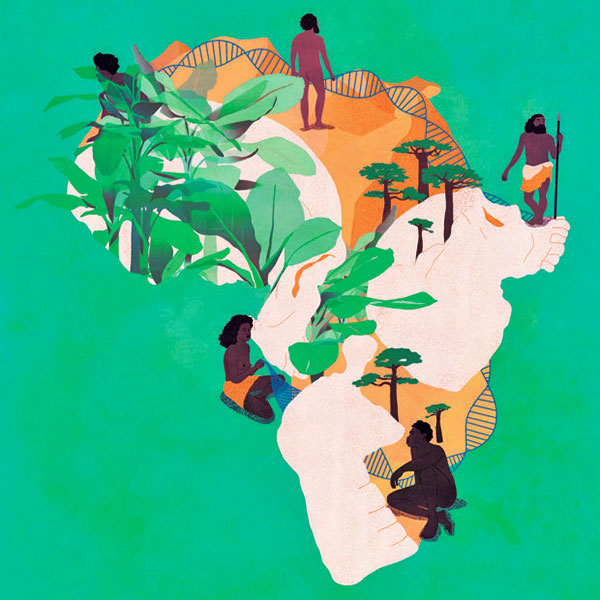
So far, many had assumed that early humans originated in Africa as a single relatively large ancestral population, but the new scientific consortium believes that the beginnings were much more diverse, with ancestors scattered across the spaced temporarily different habitats continent such as forests or deserts.

Milenios separation resulted in an astounding variety of human forms, which mixture finally gave rise to Homo sapiens.


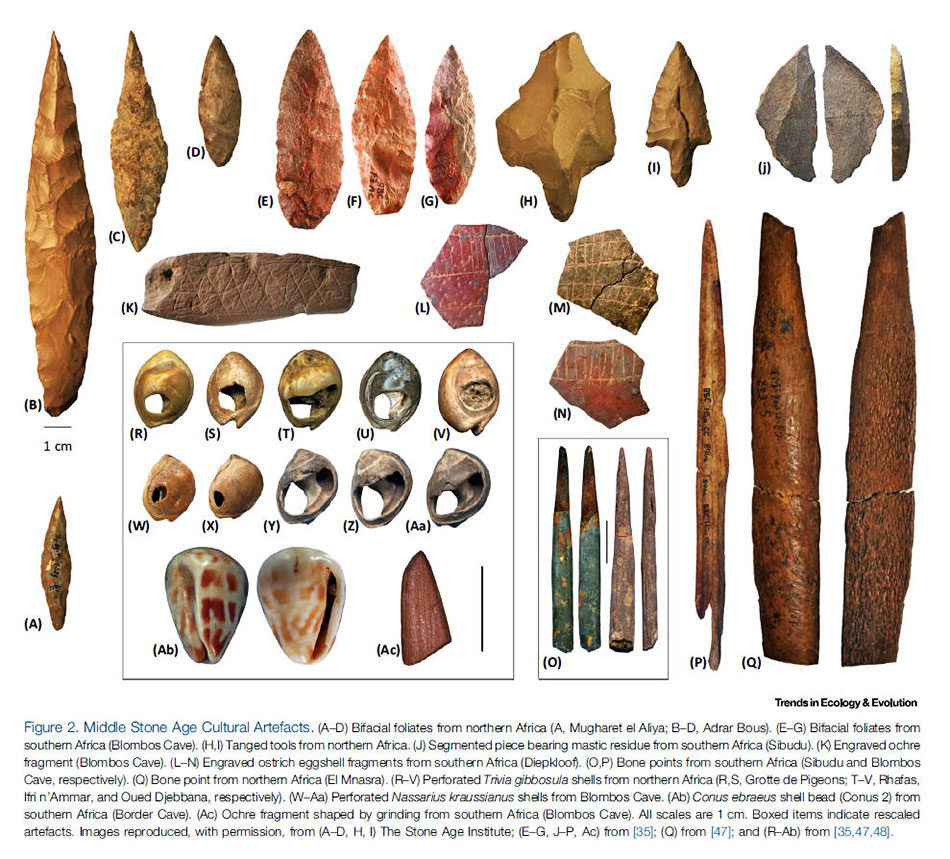
cultural artifacts from the Stone Age
North and South Africa.
Eleanor Scerri / Francesco d'Errico / Christopher Henshilwood
 

While it is widely accepted that our species was born in Africa, it is unclear how we evolved within the continent.

In an article ( Did our Species Evolve in subdivided Populations across Africa, and Why Does It Matter ? ) Published this week in the journal Trends in Ecology and Evolution ', the team puts into question the idea that there was a single population interchanged genes and technologies such as stone tools of a more or less random. 

From the study of bones, stones, genes and something much less common such as new and more detailed reconstructions of climates and habitats of Africa in the last 300,000 years, researchers have come to their own conclusions, much more complex.
"The stone tools and other artifacts, generally known as material culture, have distributions significantly clustered in space and time , " says lead study author Eleanor Scerri , of the University of Oxford in the UK and the Max Institute Planck Science of Human History in Germany.

"While there is a continental trend towards more sophisticated material culture, this 'modernization' clearly does not originate in a region or place in a given period".


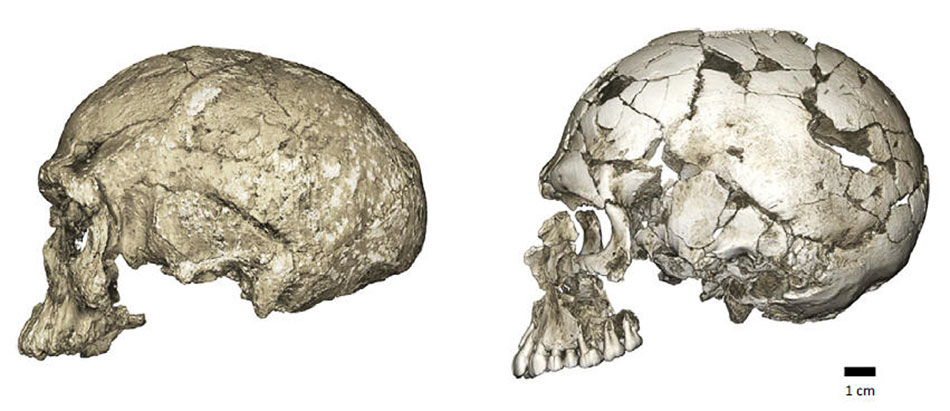
Evolutionary changes the shape of the braincase
from an elongate shape to a globular shape.
The latter evolves within the lineage of Homo sapiens
through an expansion of the cerebellum and parietal bulge.
Philipp Gunz, Max Planck Institute for Evolutionary Anthropology


Human fossils tell a similar story.
"When we look at the morphology of human bones in the last 300,000 years, we see a complex combination of archaic and modern at different places and at different times traits," says Chris Stringer, a researcher at the Museum of Natural History in London and co-author in the study .

"As with material culture, if we see a continental trend towards modern human form, but different modern features appear in different places at different times, and some archaic features are present until very recently."


Isolation cycles

Genes agree.
"It is difficult to reconcile genetic patterns we see in living African and DNA extracted from the bones of Africans who lived in the last 10,000 years, with the existence of an ancestral human population," says Professor Mark Thomas, geneticist University College London and co-author of the study.

"We see signs of a deep reduced connectivity in the past, some very old and levels of overall genetic diversity than a single population would cost you to keep bloodlines."
To understand why human populations were so divided, and how these divisions changed over time, researchers looked past climates and environments of Africa, which give a picture of the habitable zones changing and often isolated.

Many of the most inhospitable regions of Africa today, as the Sahara, were one wet and green again, with interlocking networks of lakes and rivers, and abundant wildlife.

Similarly, some tropical regions are humid and arid green today were one time.These changing environments influenced human populations, which have gone through many cycles of isolation.

This lead to local adaptation and development of a material culture and unique biological composition, followed by genetic and cultural mixture.
"The evolution of human populations in Africa was multiregional. Our descent was multiethnic. And the evolution of our material culture was multicultural," said Scerri.

"We have to look at all regions of Africa to understand human evolution.

Entrada destacada

PROYECTO EVACUACIÓN MUNDIAL POR EL COMANDO ASHTAR

SOY IBA OLODUMARE, CONOCIDO POR VOSOTROS COMO VUESTRO DIOS  Os digo hijos míos que el final de estos tiempos se aproximan.  Ningú...