https://misteri1963.blogspot.com.esgoogle.com, pub-5827770858464401, DIRECT, f08c47fec0942fa0https://misteri1963.blogspot.com.argoogle.com, pub-5827770858464401, DIRECT, f08c47fec0942fa0https://misteri1963.blogspot.com.cogoogle.com, pub-5827770858464401, DIRECT, f08c47fec0942fa0https://misteri1963.blogspot.com.brgoogle.com, pub-5827770858464401, DIRECT, f08c47fec0942fa0 google.com, pub-5827770858464401, DIRECT, f08c47fec0942fa0 Misteri1963

Translate

martes, 3 de octubre de 2017

Israel sent military instructors to Iraqi Kurdistan

Fifty years ago, in the mid-1960s, when the Shah still ruled in Iran, Israel sent military instructors to Iraqi Kurdistan to create the Peshmerga army and distress the Arab countries, especially Iraq, which then lived a offensive of nationalist and revolutionary forces. 


The Mossad sent Colonel Tzuri Sagi as an instructor of Kurdish forces to be deployed in northern Iraq, while organizing several attacks on Saddam Hussein that would be imputed to the Kurdish peshmergas to demonstrate their capability as a "liberation" movement.


In Kurdistan the spy maintained contact with the clan leader, the mullah Mustafa Barzani, father of the current leader of the Regional Government of Erbil. There are numerous photos showing both posing in the mountains of Kurdistan: Other photos show the Zionist agent disguised as a Kurd and in the company of the Pershmergas commanders he was training: For half a century, then, the Barzani have been working for Israel. Even photos of Mustafa Barzani are preserved with Meir Amit, the Mossad's top leader in those years:


Historically the Barzani clan were one of the most important and influential Kurdish tribes, in addition to being some of the initiators and organizations of the Kurdish nationalist. Today, the Regional Government has been in control of the referendum to achieve independence. 

In 2005, Masud Marzani, son of Mustafa, was elected President of the Regional Government with a mandate of eight years, that is to say that he should have discharged his position in 2013, although the Parliament extended to him another two years, two years ago I should have left it. He has not called Parliament precisely to avoid being dismissed. 

His son, Mansur Barzani, heads the security council, so he controls the police and military intelligence services, always on behalf of the Mossad.

His nephew, Nechirvan Barzani, is the Prime Minister of the regional government. He is one of those responsible for allowing jihadists to seize Mosul and the Sinjar region in 2014, inhabited by Yazidis. 

The Barzani took advantage of the retreat of jihadists to expand their territory, but did not allow the Assyrian and Yazidí refugees to return to their former territories, a case of ethnic and religious cleansing . 

Further information: 

- In Iraq, Kurds have been placed under Israel's tutelage 
- Israel wants a Kurdish state independent of Iraq 
- Israel reiterates its support for the right of self-determination of the Kurdish people 
- Israel speaks out in favor of Iraqi Kurdistan
- The multiple branches maintained by the Zionists in Kurdistan 
- The honeymoon between Zionists and Kurds 
- Imperialism agasaja to 'the Kurds'


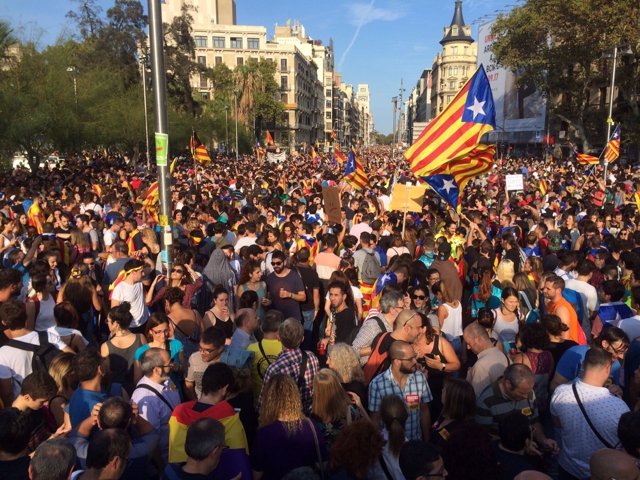
Òmnium exige al Parlament proclamar la independencia tras la movilización de este martes

Acto de la Taula per la Democràcia en la plaza Universitat de Barcelona

Òmnium exige al Parlament proclamar la independencia tras la movilización de este martes

 BARCELONA, 3 Oct. (EUROPA PRESS) -    El presidente de Òmnium, Jordi Cuixart, ha exigido al Parlament proclamar la independencia "sin más dilación" porque interpreta que es lo que exige la multitud de ciudadanos que han salido a las calles este martes en contra de la actuación policial el 1-O.    En declaraciones a los periodistas en el acto de la Taula per la Democràcia en la plaza Universitat de Barcelona, Cuixart ha destacado la capacidad del pueblo para "parar todo el país".    ...

Leer mas: http://www.europapress.es/catalunya/noticia-omnium-exige-parlament-proclamar-independencia-movilizacion-martes-20171003195727.html

(c) 2015 Europa Press. Está expresamente prohibida la redistribución y la redifusión de este contenido sin su previo y expreso consentimiento.

'We are with you Catalunya' - the revolt in Spain is bigger than the flags and tongue Paul Mason


Two million Catalans braved the threat of a boot in the face police to demand independence. Like it was a modern and cosmopolitan form of nationalism in Scotland and Greece, the first group that tried to build the barricade were the schukids. They linked the crash barriers together through the alley and tied with wire of an inch thick. The next group, young men with scraggly beard and girls hooded expressed contempt wanted to amass the barriers over some bags of cement. While they discussed options, he came a third group, the original structure dismantled and rebuilt as a fascinating 20 feet deep. This was at the Industrial School on Sunday night, a university complex that serves as

the independence referendum in Catalonia . The vote had been illegal by the Spanish State considered, but mandatory by the Catalan government, most of which had been built around a single issue: independence or failure. At this point, images of police violence against peaceful voters, young and old, passed through social networks. Old fell to the ground; women fleeing beaten with batons; a man jumped half a flight of stairs by a fully armored riot police. These images were horrifying in Europe , but the thousands of people working in the school yard did not seem frightened or surprised. Catalan leader calls for mediation with Spain for independence


After the referendum on Scottish independence in 2014 , and the Greek vote to reject austerity in June 2015 , people resisting economic and social order in Europe know that terror tactics frightened by the state are part of the agreement. Although brutal, the actions of the Civil Guard on Sunday were calculated: the selection of riot squads outside areas where casual hatred of the Catalans is abundant; in targeting the elderly and women; and the timely nature of the interventions that people in the barricades thought concentrated in middle - class areas. After the Catalan referendum: what happens next?


There were thousands of riot police on hand, on ships in the harbor. If Madrid had wanted, he could have confiscated all the polls in a matter of minutes, willingly stuck smartphone application that the Catalan authorities used to compare the results with the electoral roll. But Prime Minister Mariano Rajoy wanted to send a subtle message: let the most ardent separatists had their vote and break their heads, scaring the rest of the population to lack of participation, including any wavering. In the six polling stations I visited in the north and east of Barcelona, only one had been closed. Behind the shattered window of community center Joan Fuster

There were two children aged 15 baseball caps, guarding one urn had hidden riot police. But voters were simply moved to other polling stations: the rear end of the queue for the nearest was just yards away. Throughout the day the vote was slow, because websites were being jammed, election officials said. But still it happened. Is why, amid the blows of cane and rubber bullets, two million people were able to issue an accounting vote, with 90% voting Yes to independence. And they voted, it seemed that a modern cosmopolitan nation was born. That is a rare event in the era of globalization, but may not be the last.


People who resist the economic and social order in Europe know that the tactics of terrorism backed by the state are part of the agreement. Photography: Images UPI / Barcroft In the district of El Clot, a suburb of the working class whose pattern of street dense echoes its medieval origins, the tables were so close that line a thousand people waiting to vote snaked around the block while across the street was another line to a different location. In the few meters between the two tails, real democracy was happening.


People stood in the rain and talked in small groups - no hand gestures or raised voices - what to do. This space of the street, with his snuff and occasional smoke marijuana, villages of wet dogs, angry pensioners and council officials requiring all change their phone to airplane mode to reduce traffic to allow the implementation of voting work . If there was consensus was that Catalonia declared independence at dusk, and would have done with Spain.

If such a measure seems illegitimate, it backed by two million potential 5.3 million votes, and in a technically interrupted survey, you have to weigh the amount of democracy against its quality. What I saw in El Clot and other districts corresponds so closely to the original form of Athenian democracy that is worth exploring parallel. The Athenians had equal rights, an equal voice in the assembly, and voted "demes" - small geographical units. They had a popular literacy - in which the language of literature and theater, the economic elite, was understandable for the people. Of course, women were excluded, as slaves, a social apartheid that marred the "ideal".


Catalonia on Sunday saw something like a true democratic participation - and that should make the EU the world and think twice before dismissing everything as a nationalist trick. Riot police prevented people entering school Ramon Llull vote. Photography: Alberto Estevez / EPA Alex, a law student 18 years in the barricade Industrial School, told me that he was not flags, even language: saw a state of Catalan size, free control the Spanish financial elite, as the best way to protect and expand their human rights. "Human Drets, human drets" - that phrase heard whizzing through dozens of conversations.


Given the fascist police response and Rajoy incendiary statement that the police had acted "serenely", you can see the point of the Catalans. Walking peacefully on the streets for hours and creating in their own communities a true democracy of coexistence, tolerance and pacifism, showed that the quality of its democratic culture was much higher than that of Franco Franco and types of Opus Dei pulling the ropes in Madrid.

But still they face the same problem as the Athenians; while ancient Athens had slaves and marginalized women, the Catalans have a million foreign residents who can not vote. There are tens of thousands of people in Catalonia who do not speak Catalan by choice; including 10% of those over 75 who say they can not understand. In addition, there are a million non-Spanish residents, ranging from vendors African items at the corners to language students from places as diverse as Japan and Wales, hanging banners from their residences declaring: "We are with you Catalunya" . Although an increasing number of foreigners understand Catalan, they are a minority.

If the Catalan claim of self-determination rested in language, folklore, Sardana dancing ability, it would be wrong rooted in the reality of the XXI century. large and successful cities like Barcelona are always open; we must always allow Spanish speakers and foreigners live, work and settle here - and have full participation in the system of government.

But Catalan nationalism has made a sustained attempt to reconcile with the globalist and cosmopolitan ideologies of modern Europe. Was Montserrat Guibernau, visiting professor at the University Pompeu Fabra of Barcelona and one of the leading academic authorities of nationalism of the century, who coined the term "cosmopolitan nationalism": a sentiment echoed in the last big rally before the vote in Plaça de Catalunya on Friday night, when migrants and refugees were invited to the stage to join a procession of "typical" members of Catalan society.

If Catalonia declares its independence this week, or sets a clear timetable for it, the success of the whole project will depend on its ability to embody cosmopolitanism, which in turn depends on whether the generation that built the barricade can print their values in the nationalism of their elders. Plays video 0:48 Spanish Prime Minister opens talks with Catalan separatists - video

Scottish, Greek and Catalan revolts were driven in part by the failure of the economic model. In 2014, 45% of Scots believed they could better protect their rights, culture and economic future without Westminster; in 2015 62% of Greeks voted to defy economic logic of the euro zone; now two million Catalans have faced the threat of a police boot in the face to demand independence within the EU and the Eurozone.

This creates both challenges ahead for Britain and the EU. The SNP, Plaid Cymru and Sinn Fein sent observers invited by the Catalan government, like the Liberal Democrats, whose leader Vince Cable condemned the repression. Eoin Ó Broin, Irish Sinn Fein MP, criticized the silence of the EU : "Nobody expected to comment on the content of the referendum , " he said. "But there is a real shock here in the absence of condemning the denial of the right to vote first, and police brutality and use of digital methods to disrupt the voting. I'm surprised that nobody in Brussels believe this was unacceptable. "

Sinn Fein's presence and its strong support for the Catalans is not academic. Anglo-Irish agreement includes the promise of a referendum on unity throughout Ireland. In the mid-2020s it is likely that voters antiunion become the demographic majority in Northern Ireland.

The claim of self - determination of Catalonia is strong - and should have been tested in a legal referendum. Instead, the whole crisis has been driven by the Madrid attack to autonomy, driven by the need to impose austerity during Eurocrisis. It is tragic to see the European centrism, which once understood the principle of self - determination, willing to dilute meet the EU standards and economic rationality and diplomatic engagement with mendacious political and Rajoy. Because progressive nationalism is not going.


From George Square in Glasgow, to Syntagma Square in Athens, there was always a Catalan flag waving above the crowd. I never understood until now that those flags were an essential part of the story. Narratives "break" of modern Europe, whether they are moving away from nation states, such as coins, in the areas of free movement or the EU itself, are based on a central fact: the current solution does not work .

'Estamos con ustedes Catalunya' - la revuelta en España es más grande que las banderas y la lengua Paul Mason


Dos millones de catalanes desafiaron la amenaza de una bota de policía en la cara para exigir independencia. Al igual que con Escocia y Grecia, se trataba de una forma moderna y cosmopolita de nacionalismo


EL primer grupo que intentó construir la barricada fueron los schukids. Vincularon las barreras de choque juntas a través del callejón y las ataron con un cable de una pulgada de grosor. El siguiente grupo, hombres jóvenes con barba rala y chicas con capucha, expresaron desprecio: querían amontonar las barreras encima de unas bolsas de cemento. Mientras discutieron las opciones, llegó un tercer grupo, desmanteló la estructura original y la reconstruyó como una fascina de 20 pies de profundidad.

Éste fue en la Escuela Industrial el domingo por la noche, un complejo universitario que sirve como el referéndum de independencia de Cataluña . La votación había sido considerada ilegal por el Estado español, pero obligatoria por el gobierno catalán, cuya mayoría se había construido en torno a un solo tema: la independencia o el fracaso.


A estas alturas, las imágenes de la violencia policial contra los votantes pacíficos, viejos y jóvenes, pasaban a través de las redes sociales. Los viejos tiraron al suelo; mujeres que huían golpeadas con bastones; un hombre saltó por la mitad de un tramo de escaleras por un policía antidisturbios completamente blindado. Estas imágenes eran horripilantes en Europa, pero los miles de personas que trabajaban en el patio de la escuela no parecían asustadas ni sorprendidas.
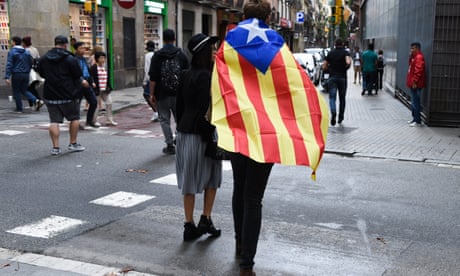


Líder catalán pide mediación con España por independencia

Después del referéndum sobre la independencia de Escocia en 2014 , y el voto griego para rechazar la austeridad en junio de 2015 , las personas que resisten el orden económico y social en Europa saben que las tácticas de terror asustadas por el Estado son parte del acuerdo.

Aunque brutales, se calculaban las acciones de la Guardia Civil del domingo: en la selección de escuadrones antidisturbios de zonas exteriores, donde el odio casual de los catalanes es abundante; en la orientación de los ancianos y las mujeres; y en la naturaleza puntual de las intervenciones, que la gente en las barricadas pensamiento se concentraba en las zonas de clase media.
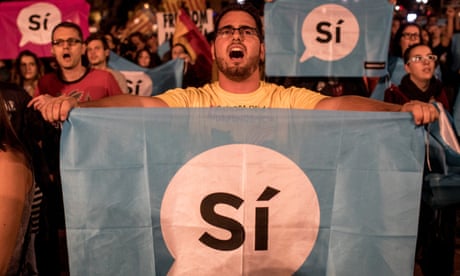


Después del referéndum catalán: ¿qué pasa después?

Había miles de policías antidisturbios a la mano, en barcos en el puerto. Si Madrid hubiera querido, podría haber confiscado todas las urnas en cuestión de minutos y, de buena gana, atascado la aplicación de smartphone que las autoridades catalanas utilizaban para comparar los resultados con el padrón electoral. Pero el primer ministro Mariano Rajoy quería enviar un mensaje más sutil: dejar que los separatistas más fervientes tuvieran su voto y rompieran sus cabezas, asustando al resto de la población a la falta de participación, incluyendo a cualquier vacilante.

En los seis centros de votación que visité en el norte y el este de Barcelona, ​​sólo uno había sido cerrado. Detrás de la ventana destrozada del centro comunitario Joan Fuster había dos niños de 15 años con gorras de béisbol, custodiando una sola urna que habían ocultado a la policía antidisturbios. Pero los votantes se habían trasladado simplemente a otras mesas de votación: el extremo trasero de la cola para el más cercano estaba apenas yardas lejos.

Durante todo el día la votación fue lenta, porque los sitios web estaban siendo atascados, dijeron funcionarios electorales. Pero aún así sucedió. Es por eso que, en medio de las bofetadas de bastón y las balas de goma, dos millones de personas lograron emitir un voto contable, con el 90% votando Sí a la independencia. Y como votaron, me parecía que una nación cosmopolita moderna estaba naciendo. Ese es un evento raro en la era de la globalización, pero puede que no sea el último.
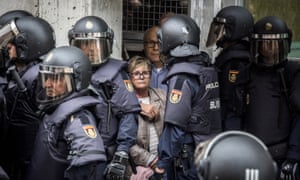
Las personas que resisten el orden económico y social en Europa saben que las tácticas de terrorismo respaldadas por el Estado son parte del acuerdo. Fotografía: Imágenes de UPI / Barcroft


En el barrio de El Clot, un suburbio de la clase obrera cuyo patrón de calle denso hace eco de sus orígenes medievales, las mesas estaban tan cerca que una línea de mil personas esperando votar serpenteaba alrededor de la cuadra mientras que al otro lado de la calle había otra línea para un lugar diferente. En los pocos metros entre las dos colas, la democracia real estaba sucediendo.

La gente se paraba bajo la lluvia y hablaba en pequeños grupos - sin gestos de mano o voces elevadas - sobre qué hacer. Este espacio de la calle, con su tabaco y los humos ocasionales de marihuana, poblados de perros mojados, jubilados iracundos y funcionarios del consejo que exigen que todos cambien sus teléfonos a modo de avión para reducir el tráfico para permitir que la aplicación de votación funcione. Si había consenso, era que Cataluña declarase la independencia al anochecer, y lo hubiera hecho con España.

Si tal medida parece ilegítima, respaldada por dos millones de un potencial de 5,3 millones de votos, y en una encuesta técnicamente interrumpida, hay que sopesar la cantidad de democracia en contra de su calidad. Lo que vi en El Clot y en los otros distritos corresponde tan estrechamente a la forma original de democracia ateniense que vale la pena explorar el paralelo.

Los atenienses tenían iguales derechos, una voz igual en la asamblea, y votaron en "demes" - pequeñas unidades geográficas. Poseían una alfabetización popular - en la que el lenguaje de la literatura y el teatro, de la élite económica, era comprensible para el pueblo. Por supuesto, las mujeres fueron excluidas, al igual que los esclavos, un apartheid social que empañó el "ideal".

En Cataluña el domingo vi algo así como una verdadera participación democrática - y eso debería hacer que el mundo y la UE piensen dos veces antes de descartar todo como un truco nacionalista.
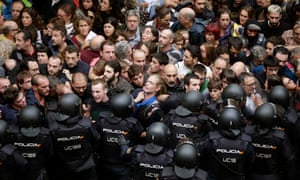
La policía antidisturbios evita que las personas que ingresan a la escuela Ramon Llull voten. Fotografía: Alberto Estevez / EPA

Alex, un estudiante de derecho de 18 años en la barricada de la Escola Industrial, me dijo que para él no se trataba de banderas, ni siquiera de lenguaje: veía un estado de tamaño catalán, libre de control por la élite financiera española , como la mejor manera de proteger y ampliar sus derechos humanos. "Drets humanos, drets humanos" - oí esa frase zumbando a través de decenas de conversaciones.

Dada la respuesta fascista de la policía y la afirmación incendiaria de Rajoy de que la policía había actuado "serenamente", se puede ver el punto de los catalanes. Al caminar pacíficamente en las calles durante horas y creando en sus propias comunidades una verdadera democracia de convivencia, tolerancia y pacifismo, mostraron que la calidad de su cultura democrática era mucho mayor que la del franquismo franquista y los tipos del Opus Dei que tiran de las cuerdas en Madrid.

Pero todavía se enfrentan al mismo problema que los atenienses; mientras que Atenas antigua tenía esclavos y mujeres marginadas, los catalanes tienen un millón de residentes extranjeros que no pueden votar. Hay decenas de miles de personas en Cataluña que no hablan catalán por elección; incluyendo el 10% de los mayores de 75 años que dicen que no pueden entenderlo. Además, hay un millón de residentes no españoles, que van desde los vendedores de artículos africanos en las esquinas hasta los estudiantes de idiomas, de lugares tan diversos como Japón y Gales, que colgaban pancartas de sus residencias declarando: "Estamos con usted Catalunya ". Aunque un creciente número de extranjeros entienden el catalán, son una minoría.

Si la reivindicación catalana de la autodeterminación descansaba en el lenguaje, el folclore, la habilidad para bailar la Sardana, estaría mal enraizada en la realidad del siglo XXI. Ciudades grandes y exitosas como Barcelona siempre están abiertas; siempre habrá que permitir que los hispanohablantes y los extranjeros vivan, trabajen y se establezcan aquí - y que tengan una participación plena en el sistema de gobierno.

Pero el nacionalismo catalán ha hecho un intento sostenido de reconciliarse con las ideologías globalistas y cosmopolitas de la Europa moderna. Fue Montserrat Guibernau, profesor visitante de la Universidad Pompeu Fabra de Barcelona y una de las principales autoridades académicas del nacionalismo del siglo XXI, que acuñó el término "nacionalismo cosmopolita": un sentimiento que se hizo eco en la última gran manifestación antes de la votación, en Plaça de Catalunya el viernes por la noche, cuando los migrantes y los refugiados fueron invitados al escenario para unirse a una procesión de miembros "típicos" de la sociedad catalana.

Si Cataluña declara su independencia esta semana, o establece un calendario claro para ella, el éxito de todo el proyecto dependerá de su capacidad para encarnar el cosmopolitismo, lo que a su vez dependerá de si la generación que construyó la barricada puede imprimir sus valores en el nacionalismo de sus mayores.


Reproduce el video

0:48 Primer ministro español abre conversaciones con separatistas catalanes - video

Las revueltas escocesas, griegas y catalanas fueron impulsadas en parte por el fracaso del modelo económico. En 2014, el 45% de los escoceses creían que podían proteger mejor sus derechos, cultura y futuro económico sin Westminster; en 2015 62% de los griegos votaron para desafiar la lógica económica de la zona euro; ahora dos millones de catalanes han enfrentado la amenaza de una bota de la policía en la cara para exigir la independencia dentro de la UE y la Eurozona.

Esto crea desafíos futuros tanto para Gran Bretaña como para la UE. El SNP, Plaid Cymru y Sinn Féin enviaron observadores, invitados por el gobierno catalán, al igual que los liberales demócratas, cuyo líder Vince Cable condenó la represión. Eoin Ó Broin, parlamentario irlandés del Sinn Féin, criticó el silencio de la UE : "Nadie esperaba que comentaran sobre el contenido del referéndum", me dijo. "Pero hay un choque real aquí en la ausencia de la condena de la negación del derecho a tener el voto en primer lugar, y la brutalidad de la policía y el uso de métodos digitales para interrumpir la votación. Me sorprende que nadie en Bruselas creyera que esto fuera inaceptable ".

La presencia del Sinn Féin y su fuerte apoyo a los catalanes no es académico. El acuerdo anglo-irlandés incluye la promesa de un referéndum sobre la unidad en toda Irlanda. A mediados de los años 2020 es probable que los votantes antisindicalistas se conviertan en la mayoría demográfica en Irlanda del Norte.

La pretensión de autodeterminación de Cataluña es fuerte - y debería haber sido probada en un referéndum legal. En su lugar, toda la crisis ha estado impulsada por el ataque de Madrid a la autonomía, impulsado por la necesidad de imponer austeridad durante la Eurocrisis.


Es trágico ver el centrismo europeo, que una vez comprendió el principio de la autodeterminación, dispuesto a diluirlo frente a las normas de la UE y la racionalidad económica, y el compromiso diplomático con un político mendaz como Rajoy. Porque el nacionalismo progresista no se va.


Desde George Square, en Glasgow, hasta la plaza Syntagma, en Atenas, siempre había una bandera catalana ondeando por encima de la multitud. Nunca entendí hasta ahora que esas banderas eran una parte esencial de la historia. Las narrativas de "ruptura" de la Europa moderna, tanto si se están alejando de los Estados nacionales, como de las monedas, de las zonas de libre circulación o de la propia UE, se basan en un hecho central: la solución actual no funciona.

Benjamin Fulford en Español: Octubre 1, 2017 Alarma nuclear de EE.UU.en Corea del Norte y Japón decide desechar al primer ministro Abe

Entrada destacada

PROYECTO EVACUACIÓN MUNDIAL POR EL COMANDO ASHTAR

SOY IBA OLODUMARE, CONOCIDO POR VOSOTROS COMO VUESTRO DIOS  Os digo hijos míos que el final de estos tiempos se aproximan.  Ningú...