https://misteri1963.blogspot.com.esgoogle.com, pub-5827770858464401, DIRECT, f08c47fec0942fa0https://misteri1963.blogspot.com.argoogle.com, pub-5827770858464401, DIRECT, f08c47fec0942fa0https://misteri1963.blogspot.com.cogoogle.com, pub-5827770858464401, DIRECT, f08c47fec0942fa0https://misteri1963.blogspot.com.brgoogle.com, pub-5827770858464401, DIRECT, f08c47fec0942fa0 google.com, pub-5827770858464401, DIRECT, f08c47fec0942fa0 Misteri1963

Translate

martes, 3 de octubre de 2017

‘We are with you Catalunya’ – the revolt in Spain is bigger than flags and language


Two million Catalans braved the threat of a police boot in the face to demand independence. As with Scotland and Greece, this was a modern, cosmopolitan form of nationalism
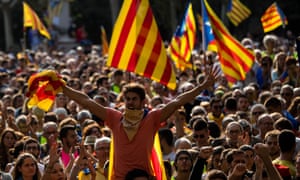
Demonstration at the Catalan high court building.
 Demonstration at the Catalan high court building. Photograph: David Ramos/Getty Images


he first group that tried to build the barricade were schoolkids. They linked the crash barriers together across the alleyway and tied them with an inch-thick cable. The next group, young men with wispy stubble and girls in hoodies, expressed contempt: they wanted to heap the barriers on top of some bags of cement instead. As they discussed the options, a third group arrived, dismantled the original structure and rebuilt it as a 20ft-deep fascine.
This was at the Escola Industrial on Sunday evening, a university complex serving as a polling station in Catalonia’s independence referendum. The vote had been deemed illegal by the Spanish state, but mandatory by the Catalan government, whose majority had been constructed around a single issue: independence or bust.
By now images of police violence against peaceful voters, old and young, were zipping across social media. Old people pulled to the ground; fleeing women hit with batons; a man jumped on down half a flight of stairs by a fully armoured riot cop . These pictures were horrifying Europe, but the thousands of people milling in the school courtyard did not look frightened or surprised.
After the referendum on Scottish independence in 2014, and the Greek vote to reject austerity in June 2015, people who resist the economic and social order in Europe know that state-backed scare tactics are part of the deal.
Though brutal, the Guardia Civil actions on Sunday were calculated: in the selection of riot squads from outside areas, where casual hatred of Catalans is rife; in the targeting of old people and women; and in the pinpoint nature of the interventions, which people on the barricades thought were concentrated on middle-class areas.
There were thousands of riot cops on hand, on ships in the harbour. If Madrid had wanted to, it could have confiscated every ballot box within minutes and, for good measure, jammed the smartphone app the Catalan authorities were using to tally the results against the electoral roll. But prime minister Mariano Rajoy wanted to send a subtler message: let the most fervent separatists have their vote and get their heads broken, while scaring the rest of the population into non-participation, including any waverers.
At the six polling stations I visited in the north and east of Barcelona, only one had been shut down. Behind the smashed window of the Joan Fuster community centre were two 15-year-old boys in baseball caps, guarding a single ballot box they had hidden from the riot police. But voters had simply moved to other polling stations: the back end of the queue for the nearest one was just yards away.
For the whole day voting was slow, because the websites were being jammed, said election officials. But it still happened. That’s why, amid the baton slaps and rubber bullets, two million people managed to cast a countable vote, with 90% voting Yes to independence. And as they voted, it looked to me like a modern cosmopolitan nation was being born. That’s a rare event in the era of globalisation, but it might not be the last.
People who resist the economic and social order in Europe know that state-backed scare tactics are part of the deal.
Pinterest
 People who resist the economic and social order in Europe know that state-backed scare tactics are part of the deal. Photograph: UPI / Barcroft Images
In the El Clot district, a working-class suburb whose dense street pattern echoes its medieval origins, the polling stations were so close together that one line of a thousand people waiting to vote snaked around the block while across the street was another line for a different venue. In the few yards between the two queues, real democracy was happening.

People stood in the rain and talked in small groups – without hand gestures or raised voices – about what to do. This street-space, with its tobacco and occasional marijuana fumes, populated by wet dogs, irate pensioners and council officials demanding everyone switch their phones to airplane mode to reduce traffic to allow the voting app to work, was alive with democratic argument. If there was a consensus, it was that Catalonia should declare independence by nightfall, and have done with Spain.
If such a move seems illegitimate, backed by two million out of a potential 5.3 million votes, and in a technically disrupted poll, you have to weigh the quantity of democracy against its quality. What I saw in El Clot, and in the other districts, corresponds so closely to the original Athenian form of democracy that the parallel is worth exploring.
The Athenians had equal rights, an equal voice in the assembly, and they voted in “demes” – small geographic units. They possessed a popular literacy – in which the language of literature and drama, of the economic elite, was comprehensible to the people. Of course, women were excluded, and so were slaves – a social apartheid that tarnished the “ideal”.
In Catalonia on Sunday I saw something like a true democratic participation – and that should make the world, and the EU, think twice before dismissing the whole thing as a nationalist stunt.
Riot police prevent people entering the Ramon Llull school to vote.
Pinterest
 Riot police prevent people entering the Ramon Llull school to vote. Photograph: Alberto Estevez/EPA
Alex, an 18-year-old law student on the barricade at the Escola Industrial told me that, for him, this was not about flags, nor even language: he saw a Catalan-sized state, free of control by the Spanish financial elite, as the best way of protecting and enlarging his human rights. “Drets humans, drets humans” – I heard that phrase buzzing through tens of conversations.
Advertisement
Given the fascist-style response of the police, and the incendiary claim by Rajoy that police had acted “serenely”, you can see the Catalans’ point. By going peacefully on to the streets for hours, and creating in their own communities a real democracy of co-existence, tolerance and pacifism, they showed that the quality of their democratic culture was far greater than that of the closet Francoists and Opus Dei types who pull the strings in Madrid.
But they still face the same problem the Athenians did; whereas ancient Athens had slaves and disenfranchised women, the Catalans have a million foreign residents who can’t vote. There are tens of thousands of people in Catalonia who do not speak Catalan by choice; including the 10% of over-75s who say they cannot understand it. Plus there are up to a million non-Spanish residents – ranging from the African merchandise sellers on the street corners to the language students, from places as diverse as Japan and Wales, who hung out banners from their halls of residence declaring “We are with you Catalunya”. Though a growing number of foreigners do understand Catalan, they are a minority.
If the Catalan claim to self-determination rested on language, folklore, the ability to dance the Sardana, it would be poorly rooted in 21st-century reality. Big, successful cities like Barcelona are always open; you will always have to allow for Spanish speakers and foreigners to live, work and settle here – and to have a full stake in the polity.


But Catalan nationalism has made a sustained attempt to reconcile itself with the globalist and cosmopolitan ideologies of modern Europe. It was Montserrat Guibernau, visiting professor at Pompeu Fabra University Barcelona and one of the leading academic authorities on 21st-century nationalism, who coined the term “cosmopolitan nationalism”: a sentiment echoed in the last big demonstration before the vote, in Plaça de Catalunya on Friday night, when migrants and refugees were invited on to the stage to join a procession of “typical” members of Catalan society.
If Catalonia does declare independence this week, or sets a clear timeline for it, the success of the whole project will depend on its ability to embody cosmopolitanism – which in turn will depend on whether the generation that built the barricade can imprint their values on to the nationalism of their elders.
 Spanish PM open to talks with Catalan separatists – video
The Scottish, Greek and Catalan revolts were all driven in part by the failure of the economic model. In 2014, 45% of Scots believed they could better secure their rights, culture and economic future free of Westminster; in 2015 62% of Greeks voted to defy the economic logic of the Eurozone; now two million Catalans have braved the threat of a police boot in the face to demand independence within both the EU and the Eurozone.

This creates future challenges both for Britain and the EU. The SNP, Plaid Cymru and Sinn Féin all sent observers, invited by the Catalan government, as did the Liberal Democrats, whose leader Vince Cable condemned the repression. Fresh from a tour of the polling stations, Eoin Ó Broin, an Irish parliamentarian for Sinn Féin, was scathing about the EU’s silence: “Nobody expected them to comment on the substance of the referendum,” he told me. “But there is a genuine shock here at the absence of condemnation of the denial of the right to have the vote in the first place, and the brutality of the police and the use of digital methods to disrupt the vote. I am shocked that nobody in Brussels thought this was unacceptable.”
The presence of Sinn Féin and its strong support for the Catalans is not academic. The Anglo-Irish agreement includes the pledge of an all-Ireland referendum on unity – and by the middle of the 2020s it is likely that anti-Unionist voters will become the demographic majority in Northern Ireland.
Catalonia’s claim to self-determination is strong – and should have been tested in a legal referendum. Instead, the whole crisis has been driven by Madrid’s attack on autonomy, itself driven by the need to impose austerity during the Eurocrisis.
It is tragic to see European centrism, which once understood the principle of self-determination, ready to dilute it in the face of EU rules and economic rationality, and diplomatic compromise with a mendacious politician like Rajoy. Because progressive nationalism is not going away.
From George Square in Glasgow to Syntagma Square in Athens, there was always a Catalan flag waving above the crowd. I never understood until now that those flags were an essential part of the story. The “breakup” narratives of modern Europe – whether they are pulling away from nation states, currencies, free movement zones or the EU itself – are all driven by a central fact: the current settlement does not work

Rothschild finiquita a Vilarrubí, el lobista del Barça y los Pujol, por su independentismo


El banco de negocios ha decidido prescindir del marido de Sol Daurella, una de las mujeres más ricas de España, por su posición política y su implicación en casos de corrupción


El empresario y vicepresidente del FC Barcelona, Carles Vilarrubí (c), acompañado de sus abogados. (EFE)


03.10.2017 – 05:00 H.

Rothschild, el banco fundado por la familia de financieros con más linaje de Europa, no quiere ver manchada su reputación por los posicionamientos políticos de sus directivos. Por este motivo, la entidad dirigida en España por Íñigo Pañeda, ha decidido prescindir de Carles Vilarrubí como vicepresidente y miembro de su consejo de administración. Una decisión comunicada el pasado 20 de septiembre, apenas 10 días antes de la celebración del referéndum ilegal en Cataluña que el también directivo del Fútbol Club Barcelona apoyaba.

La decisión fue adoptada internamente por Rothschild antes del verano después de que su presidente en Madrid, Alexandro Daffina, analizase si la actitud de Vilarrubí y sus implicaciones en escándalos de corrupción en favor de la familia Pujol estaban perjudicando a la reputación del banco. Una entidad fundada hace más de 200 años bajo el lema 'concorcia, integratas, industria', tres palabras grabadas en el histórico escudo heráldico de la familia y que se traducen por 'en armonía, honestidad y con diligencia'.

Según distintas fuentes, las dudas sobre la conveniencia de mantener a Vilarrubí como consejero y vicepresidente de Rothschild vienen de lejos. Especialmente cuando en noviembre de 2015 la Unidad de Delincuencia Económica y Fiscal (UDEF) hizo un registro policial en su domicilio en busca de pruebas por su presunta participación en el pago de comisiones a los Pujol. Un caso por el que finalmente fue imputado tras comprobar la polícía 'las mordidas' al clan del expresidente de la Generalitat y por el que tuvo que ir a los juzgados a declarar.


Vilarrubí, vicepresidente del Barça, pagó a Jordi Pujol Jr. cientos de miles de eurosANTONIO FERNÁNDEZ. BARCELONA
Un informe de la UDEF vuelve a poner en la picota la especial 'relación' entre el actual directivo del Barça y el hijo mayor de los Pujol Ferrusola, y los 'pagos' a sus cuentas


Otras fuentes indican que, tras este escándalo, Vilarrubí había asumido un papel más secundario en Rothschild. Contratado como ‘senior advisor’ —asesor de primer nivel—, su función era cultivar los negocios de la entidad financiera en Cataluña. Una labor que le dio buenas rentabilidades gracias a sus relaciones con Florentino Pérez,presidente de ACS y del Real Madrid; Antonio Hernández, presidente de Ebro Foods; los Carulla, conocidos independentistas propietarios de Agrilomen (Gallina Blanca,, y los Godó ('La Vanguardia'), entre otros.

De hecho, subrayan que en muchas ocasiones ya no acudía a las reuniones que la dirección de Rothschild España convocaba todos los lunes para repasar las operaciones en que la entidad financiera está implicada. La justificación es que se había trasladado a vivir a Londres siguiendo los pasos de su mujer, Sol Daurella, la millonaria presidenta de Coca-Cola Iberian Partners y accionista destacada de la embotelladora de la marca estadounidense de refrescos.
Informe interno

Lo cierto es que Alexandro Daffina e Íñigo Pañeda encargaron a sus abogados un estudio para analizar si la continuidad de Vilarrubí era perniciosa para la reputación del banco. La unidad de auditoría y cumplimiento de la entidad, presente en 40 países y con una plantilla de 3.400 empleados, realizó un informe para contrastar si su presencia en el consejo de administración perjudicaba la reputación de la histórica institución financiera.

La salida oficial de Rothschild se produjo el pasado 20 de septiembre. Su asiento lo ha ocupado Alfonso Cortina de Alcocer, expresidente de Repsol y ya miembro del consejo asesor europeo del banco y ‘senior advisor’ de la entidad para España y Latinoamérica. El domingo dimitió también como vicepresidente del Fútbol Club Barcelona, del que era responsable de relaciones institucionales, después de que la directiva y los jugadores del primer equipo rechazasen su propuesta de no jugar el partido contra la Unión Deportiva Las Palmas tras los acontecimientos vividos en Cataluña.

De momento, el que fuera consejero de Telefónica tras el pacto de José María Aznar con la antigua Convergència i Unió en 1996, continúa como presidente en España de Willis S&C Corredería de Seguros y Reaseguros, la multinacional de origen londinense y que cotiza en la Bolsa de Nueva York. Otras fuentes indican que su continuidad en esta firma también está cuestionada internamente.

Catalonia has every right to be an independent country because it is a nation-fledged

Salto of Spain Vacuum Rodolfo Good Rebellion In Catalonia, Spanish province located on the shores of the Mediterranean Sea, in northeastern Spain, of the 7.5 million Catalans about 5.3 million were to vote in the referendum on October 1, but only about 40% voted for a single question: Do you want Catalonia is an independent state as a republic? Popular consultation for violating the 1978 Constitution, which enshrines the unity of the country, was banned by the central government of right of Mariano Rajoy, who deployed additional police forces to prevent its realization and violently repressed those who wanted to participate. While is true that


Resultat d'imatges de autodeterminació de catalunya


Catalonia has every right to be an independent country because it is a full- fledged nation , that is: it is made up of a community of free beings consolidated and stable historical significance; It has a common language, Catalan, Castilian addition; its citizens live in a collective territory with developed economic life, with cultural heritage and national character itself and specific physical and spiritual traits that distinguishes other Spanish Catalans.  In other words, it has a range of attributes to form a separate country of Spain.

It is also true that the Iberian Peninsula is made up of a number of nations with its own characteristics: Basques, Galicians, Andalusians, Valencians ... and, therefore, with equal right that the Catalans to form their own country, which would mean the disintegration of Spain, until now a multinational state. This disintegration aftermath would bring the possible fragmentation of the European Union, EU, now existential crisis for being such problems afflicting other members of this community.

The EU needs to be refounded not destroyed. You must cease acting as a vassal of the US hegemonic interests in its apparent fight against terrorism, actual camouflage for the application of the doctrine of "constructive chaos" that imperialism has scattered and implemented across the globe.


 It's time to fight the austerity policy applied in the EU , 

It has impoverished its people, politics implemented by the pressures on all states impose a handful of bankers, that reduce the real incomes of governments 

Therefore, the stronger the desire of Catalan independence, the higher should sound the call for unity by not only the rest of Spain but of all affected sectors in Europe and the world, because this movement, character essentially nationalist It does not contribute to the formation of a strong, independent EU, which jointly meet the needs of its members but only the desire for independence, just maybe, a Catalan social sector.

Self-determination is a positive solution to the Catalan problem and the rest of the EU with similar difficulties, which can only be resolved in connection with the time currently living Europe and the world. 

Resultat d'imatges self-determination of Catalonia

Against self - determination no objection. If a nation 's struggle for independence, no one should oppose it. If Catalonia wants no part of Spain, you should not put obstacles But it requires a fully democratic general law for the creation of a federative state, prohibiting all current privileges and based on the principle of equal rights for all nations. 

It is enjoying the self-determination principle of the Catalan people and the other peoples of Spain and Europe within multinational states; that all have equal privileges and duties and to organize themselves as they please, as their desires and principles of autonomy to freely determine their destinies; that may have federal relations with other nations and even completely separated as long as not undermine the jurisprudence of other nations, as regulated in Canada.

 To exit the quagmire in which Spain is, would have to give the current government, the democratic forces, not yet formed, win a new election for such a program be fulfilled in a society for which the Franco regime and the Popular Party, Rajoy, represent an almost medieval backwardness. Sadly, this is like asking the impossible, for the kingdom of Spain, led by Rajoy, is the direct heir of Franco, who massacred and viciously persecuted the Catalan people, who even forbidden to speak in their mother tongue, is also heir Aznar government, which was complicit in the war against Iraq, in which he participated willingly.

Resultat d'imatges of Spanish dictatorship


Curious absurd, if the Prime Minister of Spain, Rajoy, would have allowed the free holding of the referendum, the Yes would not have obtained the overwhelming majority that obtained 90%. The brutal repression of demonstrations, harassment of those who wished toparticipate in the election, about a thousand injuries caused by police forces (one hundred gravity), the persecution of the organizers of the referendum, destruction and appropriation of ballots , attacks on computer systems, was what turned the opinion of the Catalans in favor of Yes.Mariano Rajoy , for which there was no referendum,

Resultat d'imatges referendum 1-O

he failed to uphold the rule of law and its authoritarian attitude has led Spain to uncertainty. According to the mayor of Barcelona, "he has crossed all red lines" and "must resign" for being a coward and "not lived up to its responsibility of state"; meanwhile, President Maduro question: "Who is the dictator?". Rebellion has posted this article with the authorpermission through a Creative Commons license, respecting their freedom to publish it elsewhere.

Entrada destacada

PROYECTO EVACUACIÓN MUNDIAL POR EL COMANDO ASHTAR

SOY IBA OLODUMARE, CONOCIDO POR VOSOTROS COMO VUESTRO DIOS  Os digo hijos míos que el final de estos tiempos se aproximan.  Ningú...